

 English
 中文简体
 русский
 Français
 عربى
 Español
Industry News
Custom HVAC Drain Pan: Applications, Selection Criteria, and Practical Guidance
A 600 × 600 mm condensate pan that sits 1.5 mm out of level will pool water in one corner and start dripping within a season. The pan itself is fine. The geometry is not. That single pattern sits behind most drain pan callbacks: the floor has no continuous fall, the drain boss stands a few millimetres proud, or the pan is too shallow to hold a weekend of condensate when a line clogs.
The practical answer is to specify a custom HVAC drain pan from the water's point of view. Slope, drain position, freeboard, seam method and material decide whether the pan stays dry. Unit price decides almost nothing about that.
Content
- 1 A Drain Pan Fails on Geometry Before It Wears Out
- 2 Material Choice Sets the Corrosion Life
- 3 Inside the Pan: Slope, Drain Boss and Folded Corners
- 4 Tolerances and the Purchase Order
- 5 Matching the Pan to the Installation
- 6 Working With a Manufacturer Who Builds Pans Every Day
- 7 Frequently Asked Questions
A Drain Pan Fails on Geometry Before It Wears Out
Three failures cover most field complaints: standing water that never drains, overflow after a line blockage, and corrosion that begins at a seam or a scratched edge. Only the third is genuinely a material problem. The first two are drawing problems.
Slope must be continuous and in one direction
A pan floor needs a single, uninterrupted fall to the outlet. One percent (roughly 1/8 in per foot) is a common minimum in sheet metal practice; coil pans are often built at 1.5–2% because dust and biofilm quickly reduce the effective slope. Two-directional or "dished" floors collect a shallow puddle in the middle no matter how carefully the frame is levelled.
Freeboard buys time
Depth above the normal water line is what stops a clogged drain from becoming a ceiling repair. The chart below models a 600 × 600 mm pan holding condensate at 1.0 L/h, a reasonable full-load figure for a small fan coil in humid weather.
Doubling freeboard from 15 mm to 30 mm roughly doubles the time a maintenance team has to find the problem. Model mechanical codes such as the International Mechanical Code already require a secondary pan with an auxiliary drain terminating where a blockage can be seen; pan depth is what makes that requirement useful rather than decorative.
Material Choice Sets the Corrosion Life
Condensate is not clean water. It carries dust, coil cleaning chemicals and biological film, and is commonly reported in the pH 4.5–6.5 range, which is mildly acidic and more aggressive on a poorly maintained coil. That is why the same pan design can last ten years in one building and three in another.
For most buyers the choice narrows quickly, and a single comparison table settles the first round of discussion.
| Material | Typical gauge | Corrosion resistance | Best fit | Watch-outs |
|---|---|---|---|---|
| 304 stainless steel | 0.5–1.5 mm | High | Long-life coil pans, coastal sites, food-adjacent areas | Cost; needs passivation after welding |
| Galvanized steel (G90 / Z275) | 0.6–1.2 mm | Moderate | High-volume OEM units with dry, dust-free coils | Cut edges and drilled holes are unprotected |
| Aluminum | 0.8–1.5 mm | Moderate to high | Lightweight rooftop and VRF pans | Pitting in chloride-rich air |
| Cold-rolled steel, powder coated | 0.7–1.2 mm | Low to moderate | Indoor units with a small condensate load | Coating damage at seams becomes a corrosion start point |
Two details matter more than the headline material. Ask for measured thickness rather than nominal gauge, because a 0.5 mm pan that arrives at 0.42 mm will sag between supports. Then protect the cut edges: a galvanized pan is only as good as its sheared and drilled faces, which carry no zinc at all.
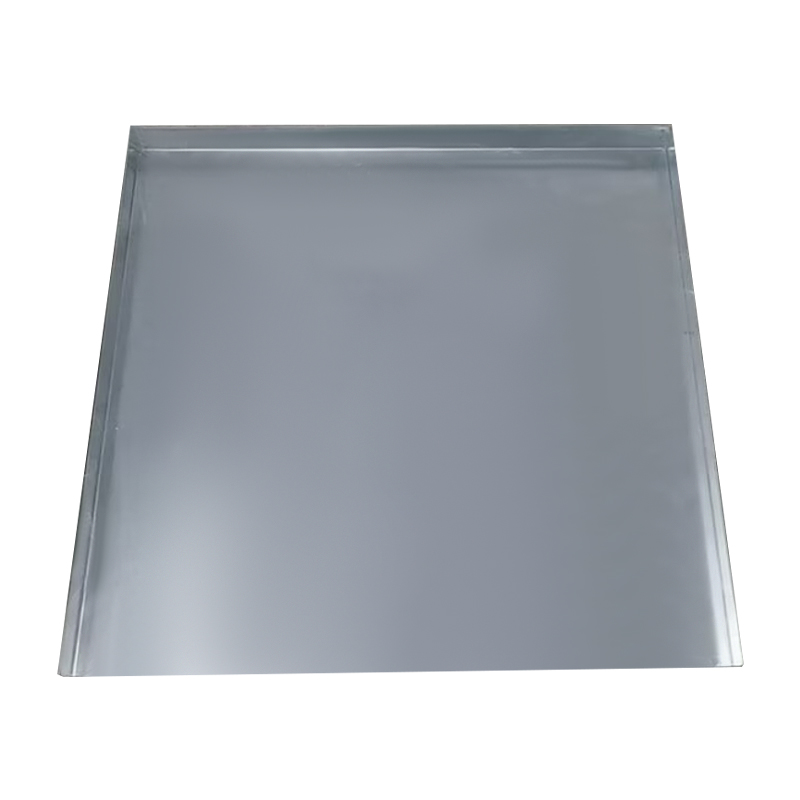 Galvanized Steel AC Drain Pans for HVAC CondensateFor HVAC condensate collection, this galvanized steel pan range offers custom sizes, optional coating or insulation, and OEM/ODM supply for commercial and residential installations.View Product →
Galvanized options in the HVAC drain pan range cover most OEM volumes; step up to stainless where the coil is washed regularly or the site sits within a few kilometres of salt water.
Inside the Pan: Slope, Drain Boss and Folded Corners
The drawing below shows the four features that decide whether a pan runs dry: a hemmed rim, a floor with a single fall, a flush outlet at the low corner, and a body stiff enough to hold its shape once it is bolted into a cabinet.
Folded corners versus welded corners
A folded and hemmed corner keeps the zinc or the coating intact and avoids a weld that would need re-passivation. Welded corners are stronger and are the right answer for large or deep pans, and for stainless units that will be pickled and passivated afterwards. Either way, agree the leak test in writing: a 24-hour fill test or a low-pressure air test with the pan submerged, not a visual check.
The drain boss is where most pans leak
The outlet must sit flush with the lowest point of the floor, not on top of it. A boss standing 3 mm proud leaves a permanent puddle that keeps the pan wet, feeds biofilm and hides the early stage of a real blockage. Specify the connection type, the boss height above the floor (zero), and the clearance underneath for the fitting and its insulation.
Insulation and the outside face
In cooling duty the pan skin runs below dew point. Uninsulated pans sweat onto ceilings and into cabinets, which is often misdiagnosed as a leaking pan. Factory-applied closed-cell foam or double-wall construction solves it, but both change the overall height, so allow for them on the envelope drawing.
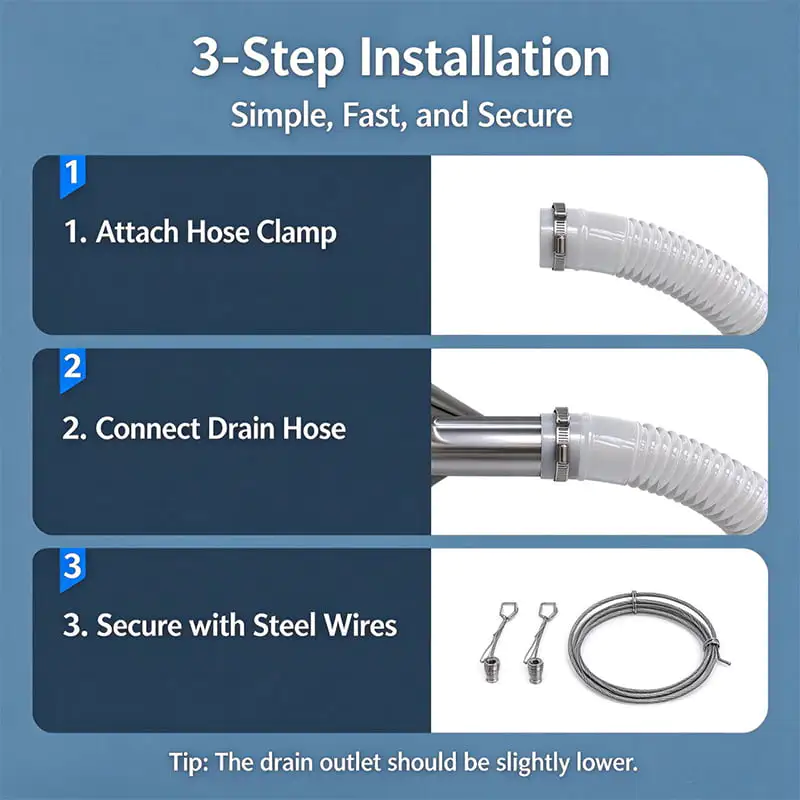 Stainless Steel HVAC Condensate Drain PanThis stainless steel collection tray manages HVAC condensate with an integrated drainage slope, optional insulation, and customizable dimensions, outlets, and mounting for varied installations.View Product →
Tolerances and the Purchase Order
Sheet metal pans are not precision parts, but the three dimensions that matter do need real numbers on the drawing. A workable set for a typical fan coil pan looks like this:
- Overall length and width within ±1.0 mm; corner squareness within 0.5 mm across the diagonal.
- Drain hole centre within ±0.5 mm, with hole diameter toleranced separately from the boss thread.
- Slope stated as a percentage plus a direction arrow, and a flatness limit on the mounting flange.
- Material grade and measured thickness, with mill certificates for stainless and a coating weight for galvanized.
- Leak test method, test duration and acceptance criterion.
- Surface treatment, such as passivation for stainless or coating thickness for painted parts, plus packing that prevents nesting scratches.
Tolerance stacking is where custom pans quietly fail. If the pan flange, the coil frame and the cabinet all carry ±1 mm and nobody checked the stack, the assembly will pull the pan out of level when it is bolted up. Ask for a first-article inspection report on the first batch and check the drain corner with a level before signing off.
Matching the Pan to the Installation
Once material and tolerance questions are settled, the shape usually follows the available space. Five criteria tend to decide between options, and they rarely point to the same answer.
Where headroom is tight, in ceiling voids, floor-standing units or retrofit work, a V-shaped or suspended pan often fits where a rectangular one will not, and both can be built to the same slope and outlet rules. The trade-off is that a deeper V needs more freeboard at the drain end to hold the same volume.
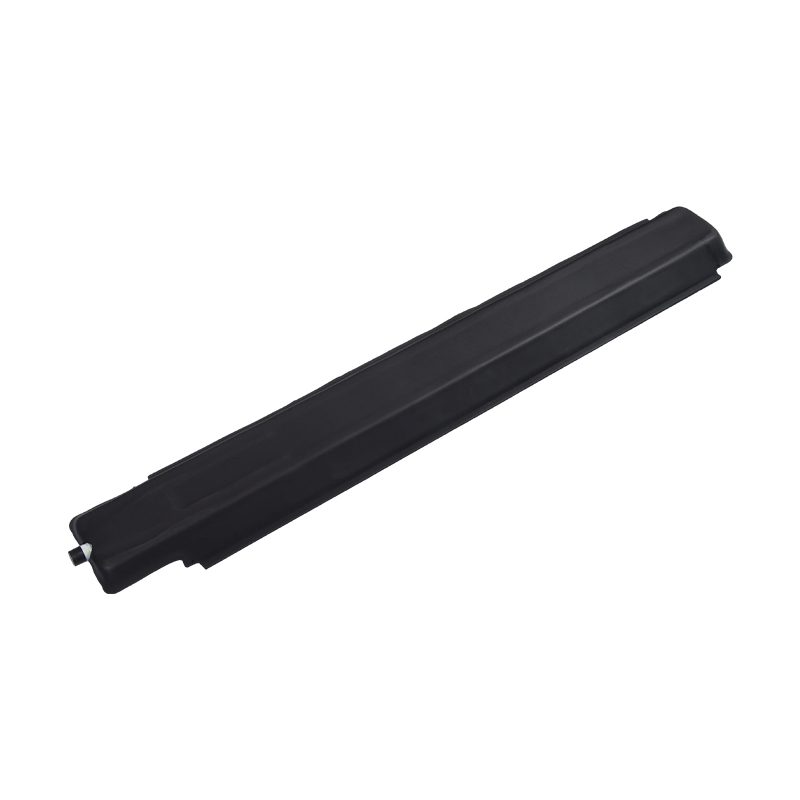 V-Shaped HVAC Condensate Water Collection TrayFor tight ceiling voids and retrofits, this V-shaped tray uses gravity drainage and customizable outlets to collect HVAC condensate in stainless, galvanized, or aluminum construction.View Product →
Working With a Manufacturer Who Builds Pans Every Day
Cixi Chenfeng Electric Co., Ltd. is a professional enterprise in the electrical field, focusing on the development and production of central air conditioning accessories. We are a professional air conditioner parts manufacturer and sheet metal parts factory. With excellent technical strength, reliable product quality and good market reputation, the company occupies an important position in the central air conditioning accessories industry. We specialize in the production of air conditioning accessories and other custom sheet metal parts, including brackets, water trays, etc., with precision manufacturing and strict quality control, we provide solid quality assurance for air conditioning systems.
In practice, that means the fall is formed in the tool rather than bent in by hand, the outlet is positioned from a jig, and the material grade is traceable to the mill certificate. For buyers running OEM programmes, the same shop also produces the brackets and vibration pads that ship alongside the pan, which removes one supplier from the coordination chain. More background is on the company profile page.
Frequently Asked Questions
Q1. What slope should a custom HVAC drain pan have?
One percent toward a single outlet is the usual minimum, and 1.5–2% where dust or biofilm is likely. Show it on the drawing as a percentage with a direction arrow.
Q2. What is the difference between a primary and a secondary pan?
The primary pan sits under the coil and collects normal condensate. The secondary pan catches overflow when the primary drain clogs, and its drain line must end where someone can actually see it.
Q3. How thick should the sheet metal be?
0.6–1.2 mm galvanized or 0.5–1.5 mm stainless covers most units. Go thicker for spans over 800 mm or where the pan is stepped on during service, and specify measured thickness rather than nominal gauge.
Q4. Can a custom pan be made to fit an existing unit?
Yes. Send the unit model, coil footprint, drain connection size and thread, and the available clearance. A reverse-engineered pan should still pass a first-article check before the batch runs.
Q5. Why is water pooling in a brand new pan?
Almost always a drain boss standing above the floor or a floor without continuous fall. Check with a level and a five-litre test pour before the unit is closed up.
Q6. How should pans be leak tested?
A 24-hour fill test, or a low-pressure air test with the pan submerged. Ask for the method and duration in writing, since a visual inspection is not a leak test.
-
Custom Square Aluminum & Stainless Steel Drain...
-
Galvanized Steel AC Drain Pans are specially desig...
-
Our Rubber Vibration Isolator Pads for HVAC System...
-
Galvanized Steel Condensate Collection Pans for Ai...
-
Our Black Plastic Meat Trays for Fresh and Frozen ...
-
Detailed Description: Crafted with pure handwoven ...


Contact info.
+86 17398066504 [email protected]
+86 17398066504
[email protected]
 +86-0574-63301198
 +86-13706742730
 No. 939, Qiye Road, Zhouxiang Town, Cixi City, Ningbo City, Zhejiang Province, China
Hot Products
Stainless Steel Equipment & Folding BBQ Grill Series Air Conditioner Drain Pan And Outdoor Unit Bracket Ventilation FansGet A Free Quote
Copyright © 2025 by Cixi Chenfeng Electric Co., Ltd All Rights Reserved. Air Conditioner Parts Manufacturers Stainless Steel Sheet Metal Parts Factory
