

 English
 中文简体
 русский
 Français
 عربى
 Español
Industry News
Outdoor Oven Manufacturer Guide: Stainless Steel Folding Ovens, Gauges and OEM Sourcing
Picture the first email from a new buyer: "Folding outdoor oven, 304 stainless, 500 pieces, FOB Ningbo — send your best price." No drawing, no gauge, no hinge requirement, no packing spec. Any figure a factory sends back at that point is a guess wearing the costume of a quotation.
The short answer for anyone sourcing an outdoor oven: cost, durability and warranty exposure are settled before the first sheet is cut, in three documents — the drawing, the material callout and the inspection plan. A manufacturer that asks for all three before quoting is usually worth the reply. One that quotes happily from a photograph is usually a trading office borrowing a factory's phone number.
What follows is the practical version of that conversation: how oven formats differ in sourcing terms, where gauge actually matters, which six points to inspect on a folding body, and how to run a first order without discovering the problems at the port.
Content
- 1 What an Outdoor Oven Manufacturer Really Controls
- 2 Which Oven Format Fits Your Channel
- 3 Gauge, Grade and Heat: Where the Specs Actually Bite
- 4 Inside a Folding Oven: Six Points to Inspect First
- 5 Sampling, Tolerances and the Checks That Prevent Claims
- 6 Working With a Sheet Metal Partner: Cixi Chenfeng Electric
- 7 Cost, MOQ and Lead Time Conversations
- 8 Frequently Asked Questions
What an Outdoor Oven Manufacturer Really Controls
Two quotes for "stainless folding oven, 500 pcs" can differ by a third and both can be defensible, because the spec is doing the talking and nobody wrote it down. Almost all of that gap sits in three places.
Steel grade and gauge
Grade is a market decision before it is an engineering one. A 304 body suits coastal and humid markets where chloride exposure is routine; 430 is magnetic, draws and polishes well, and is often chosen where the oven is stored indoors and cost pressure is high; 201 is the cheapest of the three and the most sensitive to forming, because tight folds and sharp radii can work-harden it into cracking. None of these is wrong on its own — what is wrong is a drawing that says "stainless steel" and leaves the choice to whoever is buying coil that week.
Gauge behaves the same way. Thickness without bracing does not buy stiffness; a 0.6 mm lid with a rolled edge and a proper return flange will outlast a 1.2 mm flat lid that flexes every time the handle is lifted.
The folding mechanism
On a folding oven the hinge and the fold clearance take more abuse than any other feature, and they are the first place field complaints surface. Pin diameter, washers, rivet versus weld, the gap between lid and body when folded, and the force needed to lock the frame open all belong on the drawing. If your supplier is only quoting a shape, this is the paragraph they cannot answer.
Finish, edges and packing
Deburring, hemming and post-weld cleanup separate a retail-ready oven from a functional one. Weld heat tint left in place is a corrosion starting point, not a cosmetic detail. And since these products ship as cartons that get stacked, dropped and rained on, carton grade and drop height are part of the product spec, not the logistics department's problem.
Which Oven Format Fits Your Channel
Before comparing factories, compare formats. The three most common outdoor oven builds sold through OEM channels answer to different retail contexts, and each one carries a specific thing that goes wrong when it is under-specified.
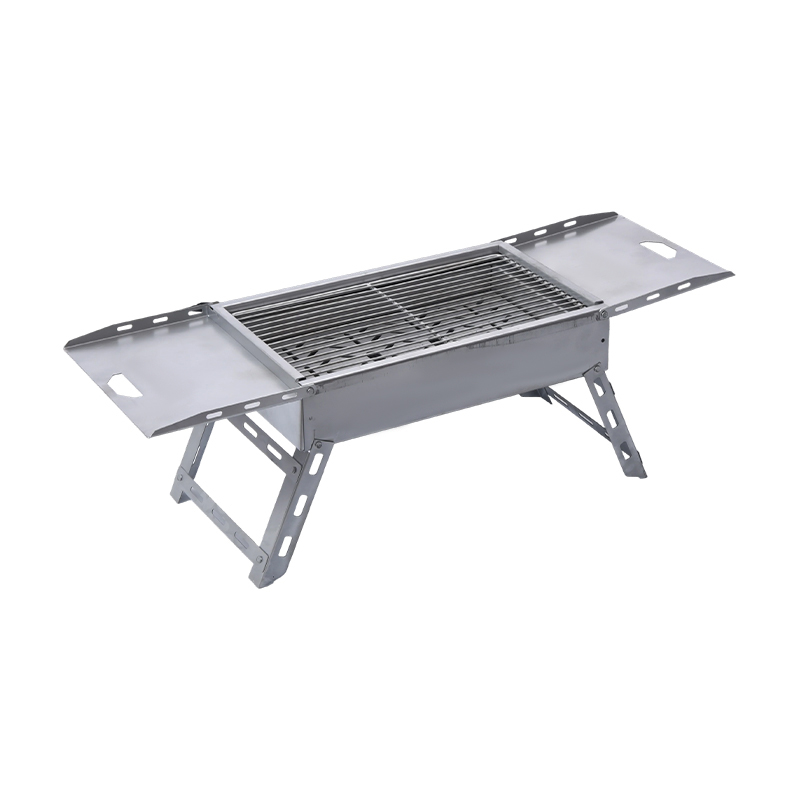
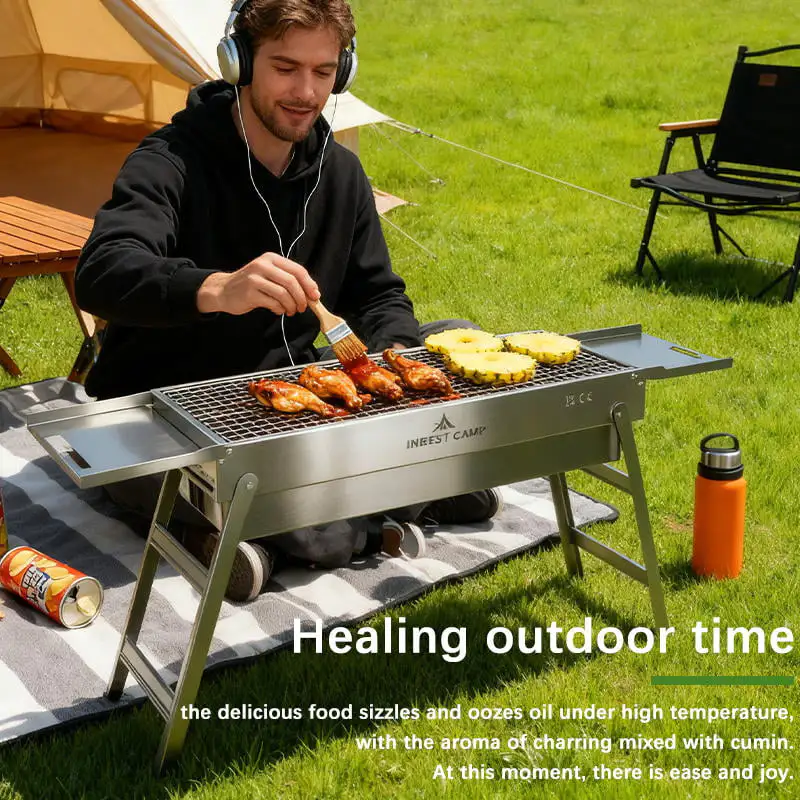 Stainless Steel Folding Charcoal OvenA pack-flat 304 stainless steel charcoal grill for 3–5 people, suited to private-label programs comparing portable outdoor oven formats.View Product →
| Format | Typical channel | Body gauge (common) | Watch first | Sourcing note |
|---|---|---|---|---|
| Outdoor stainless folding oven | Garden, camping and caravan retail | 0.6–1.0 mm body, 1.0–1.2 mm fire tray | Hinge play and folded clearance | Lock the open position and the lid stop before tooling |
| Portable folding charcoal grill | Tailgate, park and promotional programs | 0.8–1.2 mm panels | Grate support and air vent area | Vent sizing should follow your burn test, not the drawing alone |
| Built-in / tabletop oven insert | Outdoor kitchens and hospitality | 1.0–1.5 mm shell | Cut-out tolerance and heat shielding | Approve a physical template before mass production |
A folding oven is the more brandable format: it packs flat, travels well and photographs nicely, which is why private-label programs tend to start there. The portable charcoal grill is the simpler build and usually the faster route to a first shipment — fewer moving parts, fewer things to get wrong in a first article.
Gauge, Grade and Heat: Where the Specs Actually Bite
Buyers often over-specify the lid and under-specify the tray. It is the other way round in practice: the fire tray and grate supports see the temperature and the load, while the lid mostly needs stiffness and a clean edge.
Indicative ranges for a folding outdoor oven; final values follow the approved drawing.
Three questions close most of the gap here. First: what grade, exactly — 304, 430 or 201, written on the purchase order. Second: what thickness on which component, tolerance included, because coil arrives in a range and forming thins the corners. Third: does the tray have a separate heat shield or an air gap, or is it welded directly to the panel that the customer's hand will touch?
For a charcoal format, the same logic moves to vent area and grate support. A grill with generous venting runs hotter and cleaner; a grill with a grate that rests on folded tabs rather than welded brackets will rattle within a season.
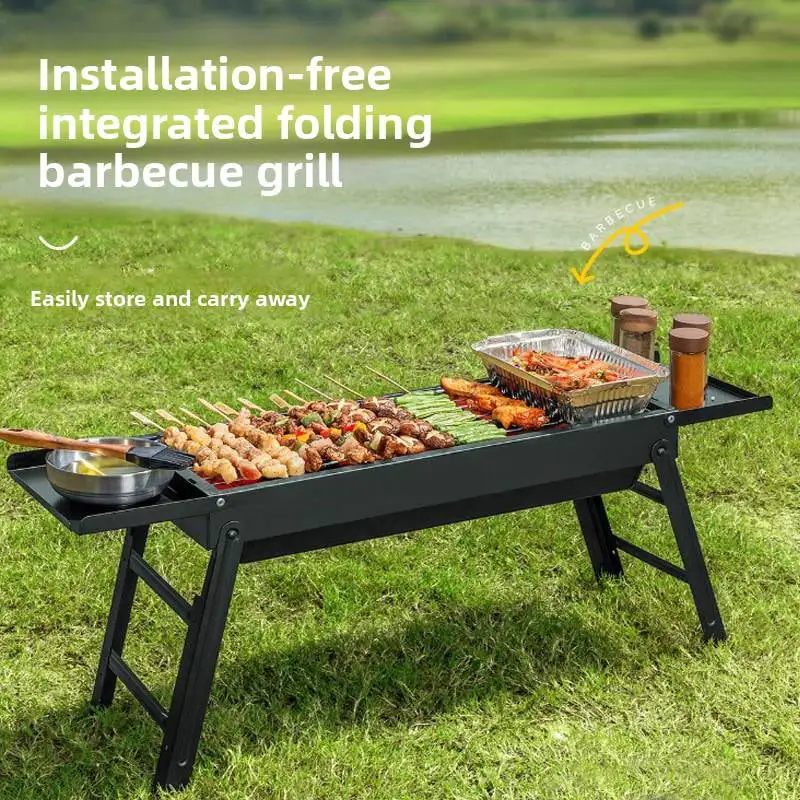 Portable Folding Charcoal Grill with Modular CombustionA compact folding charcoal grill with detachable charcoal box and damper adjustment, useful for briefing supplier reviews on joints and venting.View Product →
Inside a Folding Oven: Six Points to Inspect First
An isometric view is a useful way to brief a supplier, because it forces the conversation onto specific joints instead of overall appearance.
- Hinge line: pin size, washer type, and whether the leaf is riveted or welded. Ask for the cycle count and the acceptable play in millimetres.
- Seam and weld condition: internal welds should be dressed and, where the spec calls for it, passivated rather than left with heat tint.
- Folded clearance: open and close the sample twenty times by hand; the lid should not scrape the body or spring past its stop.
- Edge finish: run a cloth along every exposed edge. Snagging means the deburr step was skipped, which usually means other steps were too.
- Grate fit: load the grate and check rock. A grate that sits on folded tabs will not stay flat after the first heat cycle.
- Packed unit: drop the carton from the height agreed in the spec and open it. Corner deformation found here is far cheaper than corner deformation found by the retailer.
Sampling, Tolerances and the Checks That Prevent Claims
The inspection plan is where a purchase order becomes enforceable. It does not need to be long — it needs to name a method and a limit for every feature that would trigger a return.
| Check | Method | What to write into the spec |
|---|---|---|
| Hinge durability | Cycled open and closed to an agreed count | Cycle count, permitted play, pass/fail before and after |
| Weld and seam | Visual plus water or dye test where relevant | Dressing and passivation required, or explicitly not |
| Fold clearance | Physical fold with feeler gauge | Minimum and maximum gap, force required to lock open |
| Edge finish | Hand check with cloth plus visual under light | Deburr, hem or radius, and which edges are exposed |
| Grate fit | Drop-in with load, flatness on a reference surface | Rock tolerance and support type (tab or bracket) |
| Packing | Drop test plus carton grade verification | Drop height, carton board grade, retail label position |
Two habits reduce first-order risk more than any clause. Approve a golden sample that both sides physically hold, photographed from six angles and signed; and agree who owns the tooling and the drawings if the program moves. Both are ordinary requests for an established OEM buyer and both are frequently skipped.
Working With a Sheet Metal Partner: Cixi Chenfeng Electric
Oven programs rarely live alone. A buyer sourcing an outdoor oven is often also sourcing brackets, trays or drain pans from the same sheet metal supplier, and consolidation is where freight and inspection costs fall.
Cixi Chenfeng Electric Co., Ltd. is a professional enterprise in the electrical field, focusing on the development and production of central air conditioning accessories. We are a professional air conditioner parts manufacturer and sheet metal parts factory, and with technical strength, reliable product quality and a good market reputation the company occupies an important position in the central air conditioning accessories industry. We specialize in the production of air conditioning accessories and other custom sheet metal parts, including brackets, water trays and outdoor stainless steel ovens, with precision manufacturing and strict quality control providing solid quality assurance for air conditioning systems and outdoor cooking products alike.
Because our background is HVAC sheet metal — stamped brackets, drain pans, folded housings — the disciplines that carry over are the useful ones: controlled bend radii, repeatable weld positions, documented material certificates, and an inspection routine built for parts that ship in volume rather than one at a time. Buyers who want to understand how we work can read our company background or take a look at the factory overview before sending a drawing.
Cost, MOQ and Lead Time Conversations
Price differences between outdoor oven manufacturers are rarely mysterious once the spec is aligned. The useful questions are these:
- What drives the unit price? Usually material grade, gauge, weld count, hinge complexity and carton specification — in roughly that order. Changing 430 to 304 moves cost more than removing a decorative bend.
- Where is the MOQ set? It follows setup and material minimums, not an arbitrary number. A repeatable design with existing tooling can start far lower than a new body pressing.
- How long is a sample? A first article usually takes a couple of weeks once the drawing is frozen; a repeat sample moves faster because the bend program already exists.
- What is the production window? Ask for the lead time from approved sample and deposit, not from "order", and ask what happens when the coil specification arrives late.
- Who pays for tooling, and who owns it? Write the answer down before the first invoice, not after.
Frequently Asked Questions
-
Our Stainless Steel Air Conditioner Outdoor Unit B...
-
Our Stainless Steel Meat Trays for Fresh and Froze...
-
304 Stainless Steel Perforated Drying Trays are sp...
-
Our 304 Stainless Steel Square Baking Trays are pr...
-
Our Stainless Steel Meat Trays are specially desig...
-
This Outdoor stainless steel folding oven is a ver...

Contact info.
+86 17398066504 [email protected]
+86 13248153410
[email protected]
 +86-0574-63301198
 +86 13248153410
 No. 939, Qiye Road, Zhouxiang Town, Cixi City, Ningbo City, Zhejiang Province, China
Hot Products
Stainless Steel Equipment & Folding BBQ Grill Series Air Conditioner Drain Pan And Outdoor Unit Bracket Ventilation FansGet A Free Quote
Copyright © 2025 by Cixi Chenfeng Electric Co., Ltd All Rights Reserved. Air Conditioner Parts Manufacturers Stainless Steel Sheet Metal Parts Factory
