

 English
  中文简体
中文简体  русский
  Français
  عربى
عربى  Español
Industry News
HVAC Condensate Drain Line Design: Sizing, Slope, Traps, Venting & Materials
Picture this: a hotel maintenance supervisor calls at 9 a.m. because water is dripping from a ceiling fixture directly below an air-handling unit. The unit is only three years old, yet the condensate line is already blocked by biofilm, the P-trap is dry because the fan has been pulling air through it, and the secondary drain pan has rusted at a seam. Each of these problems was quietly locked in during the design phase.
The conclusion is simple: condensate drain line design determines whether moisture leaves an HVAC system without drama or turns into a repeated leak. Four decisions — pipe sizing, slope, trapping, and material selection — control almost every drain failure an installer will ever see. This guide explains each one, with the numbers that matter and the pitfalls that trip up otherwise careful installations.
Content
- 1 Why Condensate Drain Design Deserves Attention
- 2 Sizing the Condensate Drain Line
- 3 Slope, Support, and Pipe Routing
- 4 Traps and Vents
- 5 Choosing Materials and Components
- 6 Designing to Prevent Common Failures
- 7 Installation and Maintenance Best Practices
- 8 Frequently Asked Questions
- 8.1 Q1. Why does my AC condensate drain line keep clogging?
- 8.2 Q2. How much slope does a condensate drain line need?
- 8.3 Q3. What size condensate drain pipe should I use?
- 8.4 Q4. Can I use PVC for condensate drain lines?
- 8.5 Q5. Why does my condensate line smell like mildew?
- 8.6 Q6. Where should the condensate drain line terminate?
- 8.7 Q7. Does every HVAC system need a condensate drain line?
- 8.8 Q8. What is the difference between primary and secondary drain lines?
Why Condensate Drain Design Deserves Attention
When humid air passes over a chilled coil, water condenses at a rate you can estimate from cooling load. A rough rule of thumb used in design practice is about one gallon per hour for every 12,000 BTU/hr of latent cooling at high humidity. In practical terms, a typical 3-ton residential system can collect 30 to 40 gallons per day in humid summer weather, and a commercial unit produces even more. All of that water has exactly one planned exit: the condensate drain line.
Getting the design right protects efficiency and indoor air quality. If the drain flows slowly or backs up, the coil and drain pan stay wet, humidity rises, and the blower can pull contaminated air through a dry trap into the conditioned space. A well-designed line, by contrast, runs quietly for years with almost no maintenance. We cover the collector itself in more depth in our guide to what an HVAC drain pan is and why it is essential, but the piping after the pan is equally critical.
Sizing the Condensate Drain Line
The International Mechanical Code sets the floor: a condensate drain must have a minimum inside diameter of 3/4 inch, and equipment with larger coils must move up in size. The table below reflects the sizing steps commonly applied in commercial and residential design practice.
| Equipment cooling capacity | Minimum pipe inside diameter |
|---|---|
| Up to 5 tons | 3/4 in (20 mm) |
| 5 to 10 tons | 1 in (25 mm) |
| 10 to 20 tons | 1-1/4 in (32 mm) |
| 20 to 40 tons | 1-1/2 in (40 mm) |
Bigger is not always better, but a modest upgrade buys real security. A 1-inch line on a 5-ton unit, for example, more than doubles the gravity flow capacity at the same slope, which matters when humidity spikes. Oversizing too far, however, reduces flow velocity and lets debris settle in the line, so stay within one nominal step of the minimum.
Production can roughly double during hot, humid peaks, so design capacity should include a safety margin.
Slope, Support, and Pipe Routing
Even a correctly sized pipe fails if it does not drain. Design practice calls for a slope of at least 1/4 inch per foot toward the termination point; some codes permit 1/8 inch per foot only for pipes 1-1/2 inches and larger. Slope is not cosmetic. At 1/4 inch per foot, water moves quickly enough to carry away fine silt and biofilm before they build into clogs.
Supports matter just as much because a sag creates a low point where water pools and sludge accumulates. The International Mechanical Code requires PVC condensate lines to be supported every 4 feet horizontally and every 10 feet vertically. If you run insulated pipe, do not let the insulation absorb the hanger's compression at each support point.
Values are approximate gravity drainage capacities with a full-flowing pipe.
Read the chart honestly and it shows that most single-unit drain lines never approach pipe capacity at the design slope. A 3/4-inch line at 1/4-inch-per-foot pitch carries roughly 2.6 gallons per minute, or about 150 gallons per hour, while a 5-ton unit at high humidity produces around 3 gallons per hour. The practical conclusion: clogs are not caused by nominal sizing. They are caused by sagging pipe, sharp transitions, poor pitching, or unmanaged biofilm. Put your effort into maintaining slope and cleanout access rather than chasing ever-larger pipe diameters.
Traps and Vents
A condensate trap does two distinct jobs: it allows water to pass toward the drain while blocking airflow through the line. Without a trap, the blower fan can pull outside air back through the drain, wasting energy, evaporating the water seal, and drawing dust or odors into the duct system. The standard trap depth is a 3-inch water seal; a smaller seal is unreliable and can be blown dry or siphoned out by negative pressure.
Placement also affects performance. The trap should sit as close to the equipment as possible, and the drain line downstream of the trap should be pitched away from the trap, not back into it. Venting is another code-required piece: an open vent line after the trap equalizes pressure and prevents the seal from being siphoned out when the system shuts down or surges. If you cannot run an open vent in a specific situation, use a condensate pump or an auxiliary drain pan to keep the system safe.
Termination may be a drywell, a floor drain, or a visible splash outlet depending on local code.
The schematic shows the layout in practice: a sloped drain pan delivers water to the primary outlet, a deep P-trap stops airflow, the horizontal run holds a continuous 1/4-inch-per-foot slope with a cleanout and vent tee, and the line ends at an approved termination. If the primary path is ever blocked, a secondary pan or overflow switch becomes the last line of defense.
Choosing Materials and Components
PVC is the default choice for condensate drain piping because it is inexpensive, easy to assemble, and resistant to the mildly acidic water typical of air-conditioning condensate. High-efficiency gas furnaces, however, produce condensate with a pH in the range of 3 to 5, so installer guidance recommends CPVC or stainless steel for those systems. Aluminum pans, common in older evaporator coils, should not be paired with very acidic condensate because the acid will pit the metal and create leak points.
The same logic transfers to drain pans. A thick, corrosion-resistant pan is the first line of defense. In humid or salt-laden environments, stainless steel or galvanized steel pans last far longer than thin cold-rolled sheet. That is where precision manufacturing becomes visible: weld seams, punched drain openings, and fold tolerances determine whether a pan sits flat, drains completely, and stays leak-free for decades.
That is also where a component manufacturer's experience shows. Cixi Chenfeng Electric Co., Ltd. is a professional enterprise in the electrical field, focusing on the development and production of central air conditioning accessories. As a professional air conditioner parts manufacturer and sheet metal parts factory, the company combines technical strength, reliable product quality, and a solid market reputation to hold an important position in the central air conditioning accessories industry. Chenfeng specializes in air conditioning accessories and other custom sheet metal parts, including drain pans, brackets, and water trays, with precision manufacturing and strict quality control that provide solid quality assurance for air conditioning systems. For OEM and ODM orders, the factory can adapt material thickness, coating, and dimensions to the condensate chemistry of a specific project. You can review the production facility here.
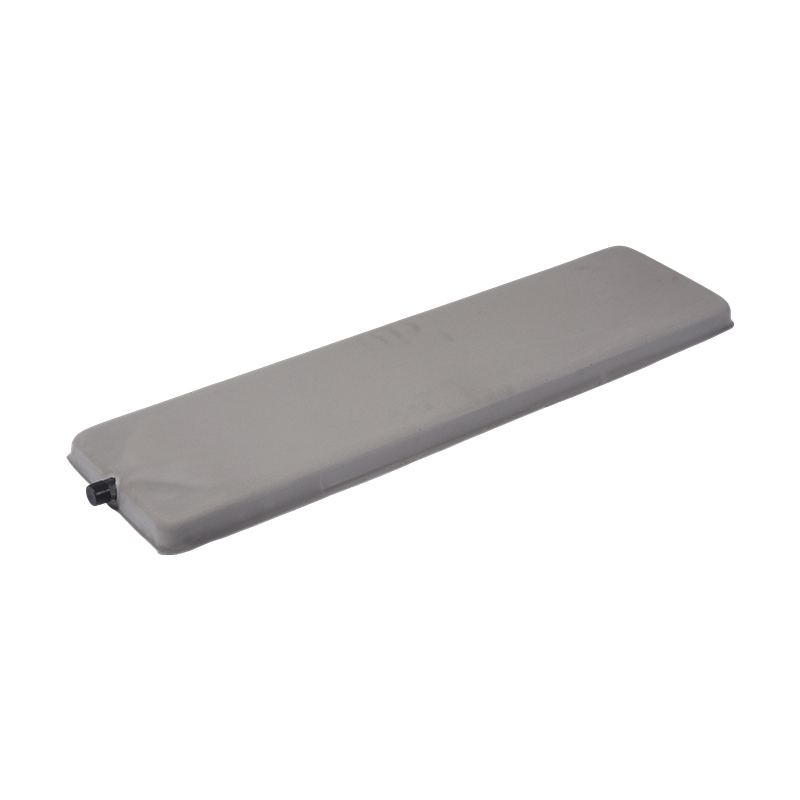 Stainless Steel Water Collection Tray for Condensate DrainageThis tray is made from high-grade stainless steel to resist moisture and corrosion, ensuring long-term durability in HVAC and industrial liquid management. The manufacturer can adjust thickness, coating, and dimensions for specific project condensate chemistry.View Product →
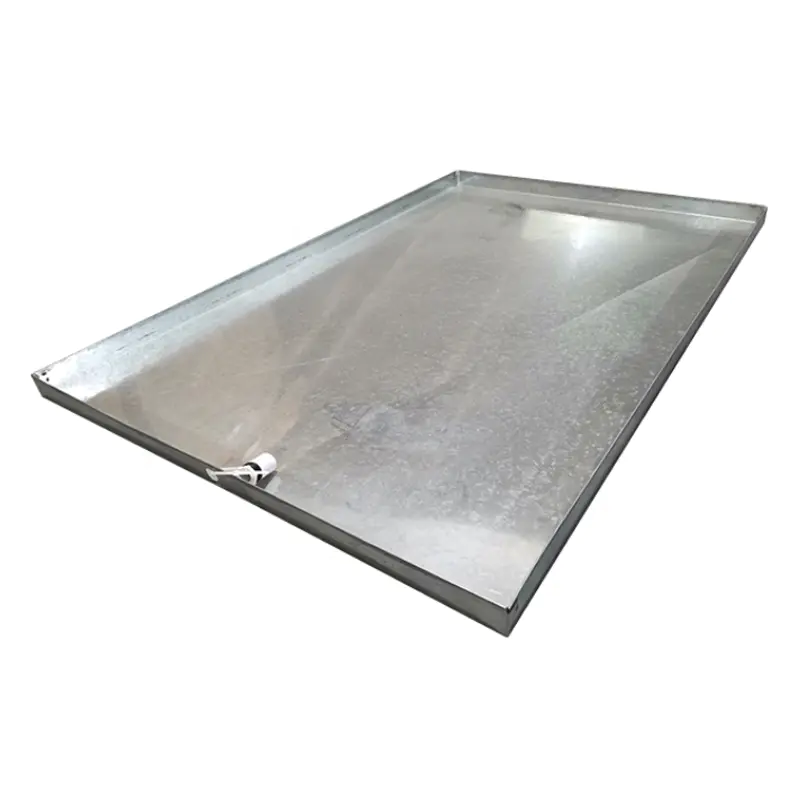
 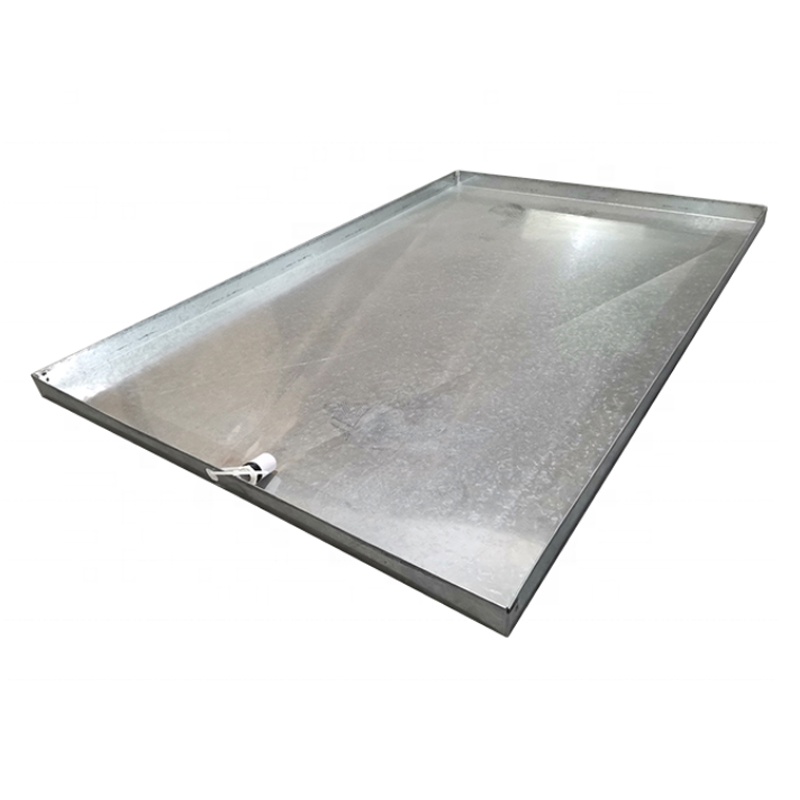 Galvanized Steel Condensate Collection Pan for HVACThis 1mm thick galvanized steel pan efficiently collects and drains condensation in air conditioning systems. Its corrosion-resistant construction supports reliable performance in commercial and industrial environments, with OEM sizing available for different unit models.View Product →
Designing to Prevent Common Failures
Design choices show up as failure modes years later. The most frequent field issues are:
- Clogged line from biofilm and sediment, aggravated by low pitch, sags, and long horizontal runs without cleanouts.
- Dry P-trap causing conditioned-air loss and odors, caused by traps shallower than 3 inches or missing vents.
- Leaks at joints and seams, accelerated by acidic condensate and wrong material pairing.
- Frozen drain line in an unconditioned attic or garage, an insulation failure more than a piping failure.
- Overflow from a blocked primary line with no functioning secondary pan or overflow switch.
| Failure | Root cause | Design fix |
|---|---|---|
| Recurrent clog | Sagging pipe, biofilm buildup | 1/4 in/ft slope, supports every 4 ft, cleanout at turns |
| Dry trap / odor | Negative pressure pulls the seal | 3-in trap depth, vent or air admittance after trap |
| Corrosion leak | Acidic condensate on thin sheet | Stainless or galvanized pan, CPVC or SS pipe |
| Frozen line | Cold attic exposure | Closed-cell insulation, heat tape in extreme climates |
| Overflow | Blocked primary line | Secondary pan and overflow switch, visible termination |
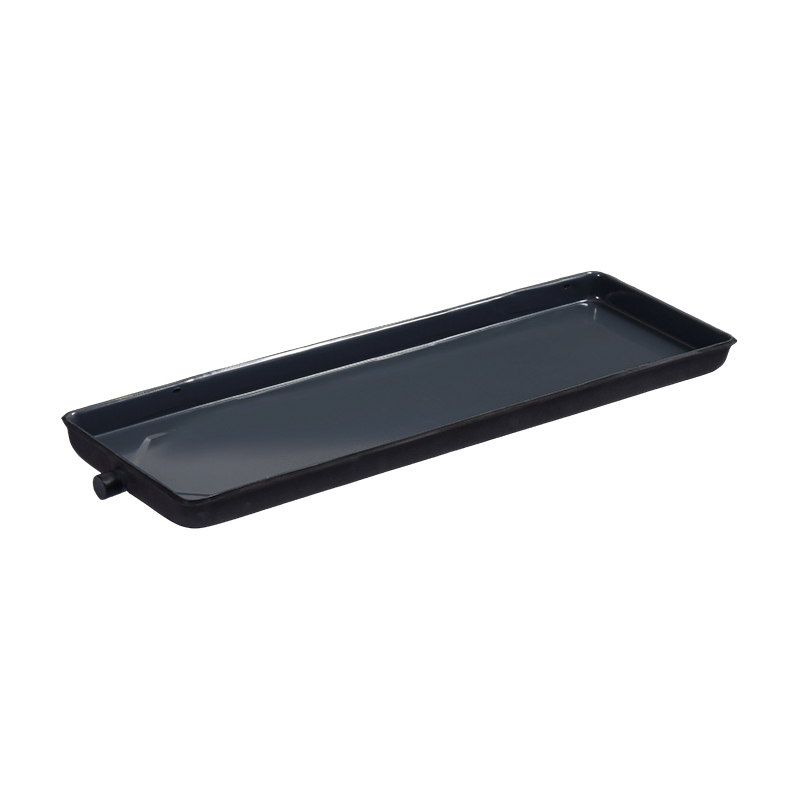
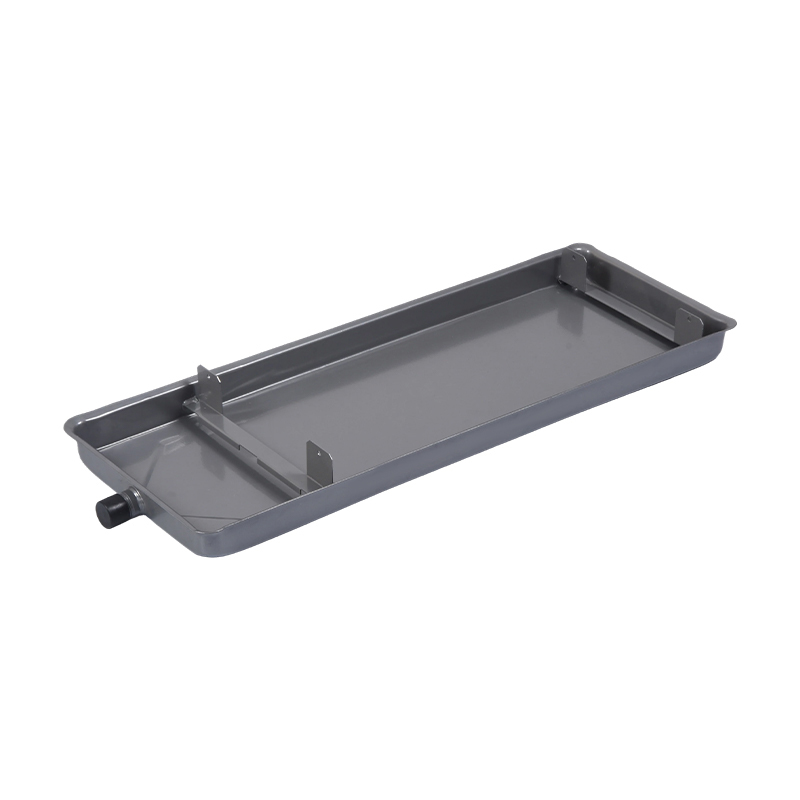
The secondary drain path deserves its own attention. A condensate tray under the unit catches overflow when the primary line is blocked, and the tray's material and slope decide whether the water stays contained until someone notices. Selecting a tray that matches the unit footprint and is rated for the site's humidity load is a small decision with outsized consequences.
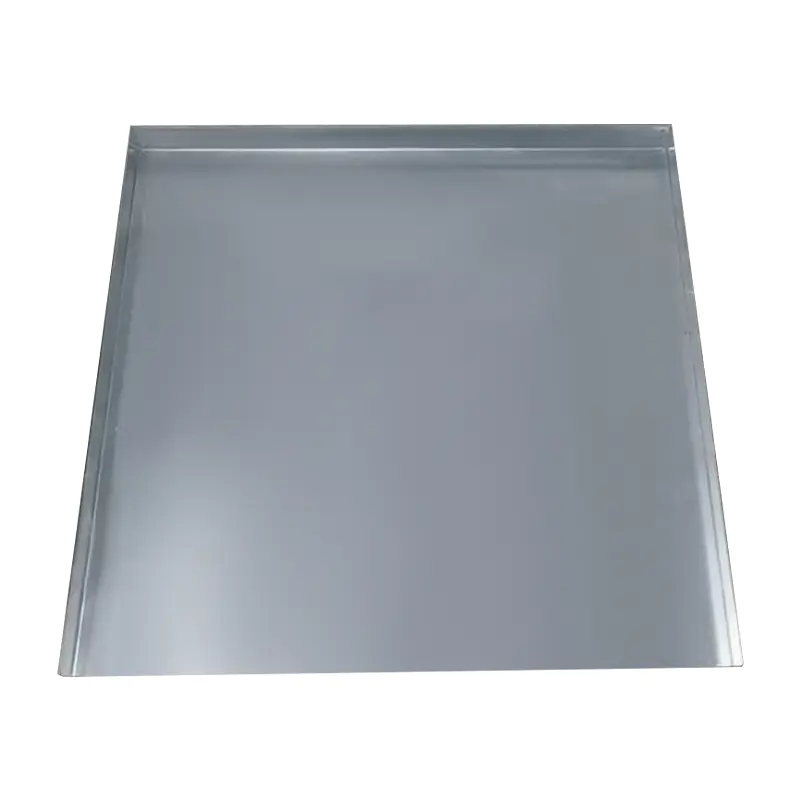
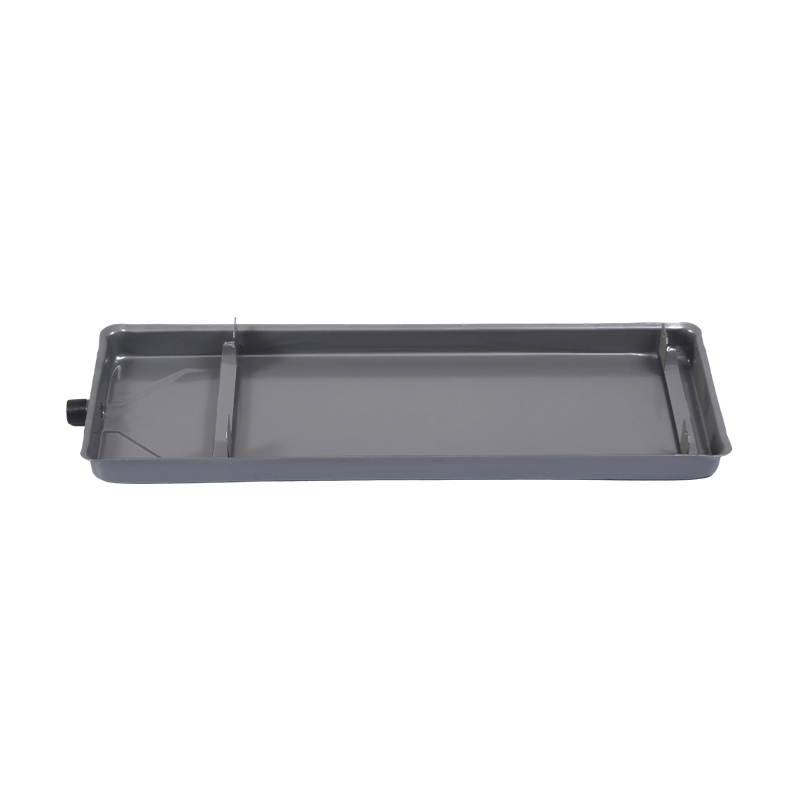 Air Conditioner Condensate Tray with Customizable FeaturesThis condensate tray is designed to collect overflow from secondary drain paths, using corrosion-resistant metal and an optimized slope to prevent pooling. Customizable size, shape, and drain position help fit various unit footprints.View Product →
Installation and Maintenance Best Practices
Design rigor pays off during installation and across the service life. From experience with hundreds of sheet metal drain components, these practices separate reliable installations from recurring callbacks:
- Test every drain line before finishing. Pour a measured bucket of water through the pan after installation; if it does not appear at the termination within seconds, find the low point or blockage before drywall goes up.
- Insulate condensate lines in unconditioned space with at least 1/2-inch closed-cell foam, and keep the insulation continuous over joints and traps.
- Install a union or coupling upstream of the trap so the trap can be removed and cleaned in minutes.
- Schedule a quarterly maintenance flush of warm water or a mild vinegar solution to keep biofilm from establishing a foothold.
- Terminate the line where it can be seen. A visible drip alerts an owner before water reaches equipment; a hidden tie-in to a floor drain leaves the problem undiscovered until flooding occurs.
One more rule from service experience: never rely on the drain pan slope alone to move water. Pans are formed with a pitch of roughly 1/4 inch over their length, but shipping, insulation, and mounting can flatten that. A shallow pool at the end of the pan is the first sign of a failed installation, and it is also the easiest cleanliness problem to catch during routine maintenance.
Frequently Asked Questions
Q1. Why does my AC condensate drain line keep clogging?
Biofilm and algae are the most common culprits. The warm, damp interior of the line is an ideal growing environment; flushing quarterly with warm water or a mild cleaner prevents recurring clogs.
Q2. How much slope does a condensate drain line need?
A minimum of 1/4 inch per foot is the standard practice. Verify the fall with a level and support the pipe every 4 feet horizontally so the pitch stays consistent.
Q3. What size condensate drain pipe should I use?
The minimum is typically 3/4 inch for units up to 5 tons. Larger systems step up to 1 inch or beyond, and some jurisdictions require a 1-inch minimum, so check local code.
Q4. Can I use PVC for condensate drain lines?
Yes, PVC is the most common material for condensate piping. Use CPVC or a heat-rated plastic on high-efficiency furnace condensate, which can be slightly acidic and warm.
Q5. Why does my condensate line smell like mildew?
A smelly drain usually means biofilm growth and a dry trap. Pour a cup of white vinegar through the line, refill the trap with water, and replace the line if the odor persists.
Q6. Where should the condensate drain line terminate?
Terminate at an approved drywell, floor drain, or visible splash outlet, never onto a public walkway or roof where it can cause ice or structural damage.
Q7. Does every HVAC system need a condensate drain line?
Any system with a cooling coil that removes moisture needs one. Heat pumps also produce condensate during defrost cycles, which is handled through a separate drain pan.
Q8. What is the difference between primary and secondary drain lines?
The primary line removes normal condensate; the secondary line or overflow switch serves as a backup if the primary clogs. Secondary drains should terminate visibly so problems are noticed.
-
Our Rubber Vibration Isolator Pads for HVAC System...
-
Galvanized Steel Condensate Collection Pans for Ai...
-
Custom Square Aluminum & Stainless Steel Drain...
-
Galvanized Steel AC Drain Pans are specially desig...
-
The Black Air Conditioner Drain Pan is a high-perf...
-
The air conditioner condensate tray is a critical ...

Contact info.
+86 15967843486 [email protected]
+86 15967843486
[email protected]
[email protected]
+86 15967843486
[email protected]
 +86-0574-63301198
 +86-13706742730
 No. 939, Qiye Road, Zhouxiang Town, Cixi City, Ningbo City, Zhejiang Province, China
Get A Free Quote
Copyright © 2025 by Cixi Chenfeng Electric Co., Ltd All Rights Reserved. Air Conditioner Parts Manufacturers Stainless Steel Sheet Metal Parts Factory
