

 English
  中文简体
中文简体  русский
  Français
  عربى
عربى  Español
Industry News
Complete Buying Guide for HVAC Drain Pans
Content
- 1 Complete Buying Guide for HVAC Drain Pans
- 2 What Does an HVAC Drain Pan Do
- 3 Where Air Conditioner Drain Pans Are Used
- 4 Materials Compared: Galvanized, Stainless Steel, and Polymer Drain Pans
- 5 Choosing the Right Pan Depth for Your Installation
- 6 How Condensate Volume Changes With Humidity and Season
- 7 Common Problems: Overflow, Rust, and Clogged Drains
- 8 Maintenance and Cleaning Schedule
- 9 Choosing a Reliable HVAC Drain Pan Manufacturer
- 10 About Cixi Chenfeng Electric Co., Ltd.
- 11 Frequently Asked Questions
Complete Buying Guide for HVAC Drain Pans
The right HVAC Drain Pan comes down to three decisions: the material that matches the humidity and exposure the unit will face, a depth and slope that matches the condensate volume the system actually produces, and whether the installation needs a secondary pan in addition to the primary one. Get those three details right and an Air Conditioner Drain Pan will quietly do its job for years, get any one of them wrong and the first sign of trouble is usually a wet ceiling or a corroded pan bottom nobody noticed until it failed.
This guide walks through how a condensate drain pan actually works, how galvanized steel, stainless steel, and polymer pans compare, how to size and slope a pan correctly, and what tends to go wrong when a pan is overlooked during routine maintenance. Whether you are specifying pans for new installations or replacing a failed one, the goal is the same: match the pan to the system and the environment it sits in.
What Does an HVAC Drain Pan Do
Collecting and Directing Condensate
As warm indoor air passes over a cold evaporator coil, moisture condenses out of the air and drips downward. A drain pan HVAC installation sits directly beneath that coil, catching every drop and channeling it toward a drain line rather than letting it collect on the floor, in ductwork, or inside a ceiling cavity. On a humid day, a mid-size residential system can produce several liters of condensate, so the pan is doing real, continuous work rather than sitting there as a formality.
Primary Pans vs Secondary Pans
Most indoor units include a primary pan built directly into the unit housing. When that same unit is mounted in an attic, a loft, or any space above a finished ceiling, a secondary pan, sometimes called an auxiliary or overflow pan, is placed underneath the entire unit as a backup. If the primary pan or its drain line ever gets blocked, the secondary pan catches the overflow and either triggers a safety switch or drains separately, buying time before water reaches the ceiling below.
Where Air Conditioner Drain Pans Are Used
Condensate drain pan requirements shift depending on where the unit sits and how much risk a leak would create. The table below outlines how pan use typically changes across common installation types.
| System Type | Typical Pan Depth | Recommended Slope | Common Material |
|---|---|---|---|
| Residential Split System Indoor Coil | 1.5 to 2 in | Slight slope toward drain outlet | Galvanized steel or polymer |
| Attic or Loft Mounted Air Handler | 2.5 to 3 in | Slope plus a dedicated overflow outlet | Galvanized steel or stainless steel |
| Light Commercial Package Unit | 3 to 4 in | Continuous slope across full pan length | Stainless steel |
| Rooftop Condensing Unit Base Pan | 4 in and above | Slope toward multiple drain points | Galvanized steel with corrosion coating |
Materials Compared: Galvanized, Stainless Steel, and Polymer Drain Pans
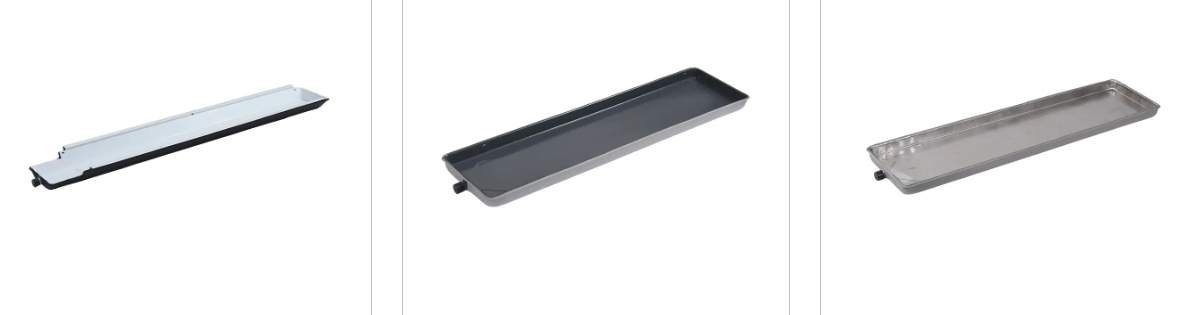
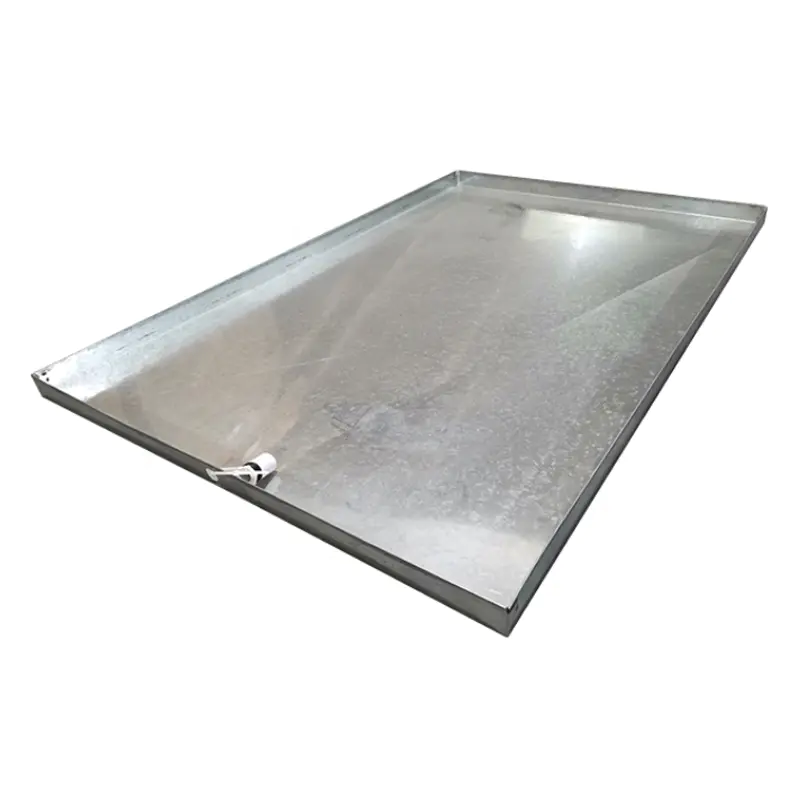
Material choice is the single biggest factor separating a metal drain pan that lasts for years from one that needs replacing early. Galvanized drain pan options offer a solid balance of durability and ease of fabrication, making them a common default for standard residential and light commercial work. A stainless steel drain pan trades some fabrication flexibility for the best corrosion resistance and the longest service life, which is why it shows up more often in commercial systems and coastal or high humidity environments. Polymer or plastic pans lean the other direction entirely, prioritizing light weight and molding flexibility over long term structural durability.
The radar chart below compares all three materials across five practical factors that matter most when choosing between them.
Stainless Steel Drain Pan Galvanized Drain Pan Polymer Drain Pan
Choosing the Right Pan Depth for Your Installation
An undersized air conditioner drain pan is one of the most common causes of overflow, simply because it cannot hold enough condensate during peak humidity before the water reaches the rim. Depth requirements scale with the type of installation, from shallow pans built into window and packaged terminal units up through deeper base pans used on rooftop equipment. The chart below compares typical pan depth across four common application categories.
Typical Pan Depth by Application (Inches)
Figure: general depth reference by application, actual pan depth should match the manufacturer specifications for the exact unit installed.
How Condensate Volume Changes With Humidity and Season
Condensate output is not steady throughout the year, it rises and falls with outdoor humidity and how hard the system is running. This is why an HVAC drain pan that seems perfectly adequate in spring can suddenly show signs of strain during the most humid stretch of summer. The line chart below illustrates a general seasonal pattern in relative condensate volume, which is useful context when deciding how much margin to build into pan capacity.
Illustrative Seasonal Pattern of Condensate Volume
Figure: general illustrative seasonal pattern, actual condensate volume depends on local climate and system run time.
Common Problems: Overflow, Rust, and Clogged Drains
Why is my AC drain pan full of water is one of the most common questions homeowners ask, and the answer is almost always a blockage rather than a failure of the pan itself. Dust, algae, and debris build up inside the drain line over time, slowing or stopping the flow of condensate until it backs up into the pan and eventually overflows. A cracked pan, corrosion at the seams, or a failed float switch are the other frequent culprits, though these tend to develop more gradually. The column chart below shows a general breakdown of how often each cause tends to come up during service calls.
Relative Frequency of Common Drain Pan Issues (Illustrative Index)
Figure: illustrative comparison of how often each issue tends to appear during routine service visits.
Maintenance and Cleaning Schedule
How Often Should an AC Drain Pan Be Cleaned
Most residential systems benefit from a pan and drain line inspection at least once per cooling season, ideally right before the weather turns warm. Homes in humid climates or with a lot of surrounding vegetation may need a check twice a year, since algae and debris accumulate faster in those conditions.
- Turn off the system before inspecting or cleaning the pan and drain line.
- Remove any standing water and check for visible debris, algae growth, or sediment inside the pan.
- Clear the drain line opening of buildup so condensate can flow freely toward the exit point.
- Check the pan surface and seams for rust spots, pitting, or hairline cracks that could widen over time.
- Test the float switch, if the pan includes one, to confirm it still shuts the system down when water rises too high.
Choosing a Reliable HVAC Drain Pan Manufacturer
Working with an established HVAC drain pan manufacturer matters more than it might seem, because pan quality is largely determined during fabrication rather than something that can be fixed after installation. A one-piece stamped or fully welded seam avoids the weak points where leaks and rust tend to start first. Look for an air conditioner drain pan manufacturer that can hold consistent wall thickness across the pan, offer both galvanized and stainless steel options, and support non-standard sizing for rooftop units, cabinet units, and other installations that do not fit a standard template.
A capable condensate drain pan supplier should also be able to adjust drain outlet position, pan slope, and overall capacity to match a specific system rather than forcing every project into the same fixed design. Optional features such as anti-mold coatings or an inclined drainage channel are worth asking about directly, since they reduce microbial buildup and standing water between cleanings.
About Cixi Chenfeng Electric Co., Ltd.
Cixi Chenfeng Electric Co., Ltd. is a professional enterprise in the electrical field, focused on the development and production of central air conditioning accessories, including condenser components and condensate drain pans. Condenser assemblies are built around high-efficiency heat exchange tubes and fin designs compatible with common refrigerants, available in copper tube, aluminum fin, or all-aluminum construction, with modular structures that adapt to multi-split systems and commercial units.
On the drain pan side, production relies on one-piece stamping or welding in galvanized steel and stainless steel, with options for anti-mold coatings and inclined drainage channels that help prevent microbial growth and standing water. Non-standard sizing is supported across rooftop units, cabinet units, and other installation types, with adjustable drain outlet position and slope to match each customer's exact configuration. As a China based HVAC Drain Pan and Air Conditioner Drain Pans factory, Cixi Chenfeng supports wholesale ODM and OEM customization backed by joint laboratory testing for airflow and drainage performance.
Frequently Asked Questions
Q1. What is an air conditioner drain pan
It is a shallow tray installed beneath the evaporator coil or indoor unit that collects condensate and channels it toward a drain line, preventing water from dripping into the surrounding space.
Q2. What does an HVAC drain pan do
It catches condensate produced as warm air passes over the cold coil, directing that water safely away from the unit rather than allowing it to pool or drip inside the building.
Q3. Why is my AC drain pan full of water
A full or overflowing pan is most often caused by a clogged drain line, though a cracked pan, rust damage, or a failed float switch can also allow water to build up.
Q4. How often should an AC drain pan be cleaned
A yearly inspection before cooling season is a reasonable baseline for most homes, with a second check recommended in humid climates or areas with heavy surrounding vegetation.
Q5. Can you replace an AC drain pan
Yes, a drain pan can be replaced on its own without replacing the entire indoor unit, as long as the replacement pan matches the depth, footprint, and drain outlet position of the original.
Q6. What is a secondary drain pan
A secondary or auxiliary pan sits beneath the entire indoor unit, typically in an attic or loft installation, catching overflow if the primary pan or drain line ever becomes blocked.
Q7. What material is best for an AC drain pan
Stainless steel offers the strongest corrosion resistance and longest service life, galvanized steel provides a durable and cost-conscious middle ground, and polymer pans prioritize light weight over long term durability.
Q8. How long does a drain pan last
Service life varies by material and environment, with well maintained stainless steel and galvanized pans commonly lasting many years, while exposure to standing water and debris tends to shorten that lifespan.
Q9. Why does an AC drain pan rust
Rust develops when the protective coating on a metal pan wears down or gets scratched, allowing standing condensate and humidity to reach bare metal over repeated exposure.
Q10. How do you stop an AC drain pan from overflowing
Keep the drain line clear of debris, inspect the pan regularly for cracks or rust, and confirm the pan slope directs water toward the outlet rather than allowing it to pool in one spot.
-
Our Rubber Vibration Isolator Pads for HVAC System...
-
Galvanized Steel Condensate Collection Pans for Ai...
-
Custom Square Aluminum & Stainless Steel Drain...
-
Galvanized Steel AC Drain Pans are specially desig...
-
The L-Shaped Bracket for Natural Gas Pipes is a re...
-
Stainless Steel (201) Price: 8 USD (Other material...


Contact info.
+86 17398066504 [email protected]
+86 17398066504
[email protected]
[email protected]
+86 17398066504
[email protected]
 +86-0574-63301198
 +86-13706742730
 No. 939, Qiye Road, Zhouxiang Town, Cixi City, Ningbo City, Zhejiang Province, China
Hot Products
Stainless Steel Equipment & Folding BBQ Grill Series Air Conditioner Drain Pan And Outdoor Unit Bracket Ventilation FansGet A Free Quote
Copyright © 2025 by Cixi Chenfeng Electric Co., Ltd All Rights Reserved. Air Conditioner Parts Manufacturers Stainless Steel Sheet Metal Parts Factory
