Cixi Chenfeng Electric Co., Ltd

Industry News

Home > News > Industry News > What Causes HVAC Drain Pan Overflow and How Can You Prevent It?

What Causes HVAC Drain Pan Overflow and How Can You Prevent It?

Author: Admin Date: Jul 30,2026

What Causes HVAC Drain Pan Overflow: The Direct Answer

HVAC drain pan overflow happens when condensate water builds up faster than the drain line can carry it away, and in most service calls the root cause traces back to a partially blocked condensate drain line. Algae film, dust, and biological sludge collect inside the drain tubing over a cooling season, narrowing the passage until water backs up into the pan and spills over the rim onto the floor, ceiling tile, or nearby equipment below.

Four other conditions account for nearly all of the remaining condensate overflow pan complaints reported by field technicians: a cracked or corroded pan that can no longer hold water, a pan installed at the wrong slope, restricted airflow caused by a dirty filter or a frozen coil, and a float switch that fails to cut power to the system before water rises past the safe level.

  • Clogged or partially blocked condensate drain line
  • Cracked, rusted, or corroded drain pan
  • Incorrect pan slope from a poor installation
  • Restricted airflow from a dirty filter or a frozen coil
  • Failed float switch or safety overflow switch

The sections below walk through each of these causes in detail, show how often each one tends to show up in the field, and outline the maintenance habits and pan material choices that keep condensate moving where it belongs instead of spilling over the edge.

Five Root Causes Behind Every Condensate Overflow Pan Problem

Clogged Condensate Drain Line

The drain line carries condensate away from the pan toward an approved discharge point, and it is the narrowest part of the entire pathway. Warm, moist conditions inside the tubing create a favorable environment for algae and mold film to form along the interior walls. Over a single humid season that film can thicken enough to slow water flow to a trickle, and once the line backs up, water has nowhere to go except back into the pan and over its edge. A seasonal flush with a mild vinegar solution or a wet vacuum pull at the outdoor termination point is one of the simplest habits that keeps this pathway open.

Cracked, Rusted, or Corroded Drain Pan

Metal pans that sit in standing water for extended periods face ongoing moisture contact, and once a protective coating wears thin, rust can eventually work through the metal from the inside out. Plastic and composite pans age differently, becoming brittle after repeated heating and cooling cycles until hairline cracks form along stress points near mounting screws. Either failure mode turns the pan itself into a leak source rather than a container, which is why a visibly rusted or hairline cracked condensate overflow pan should be inspected closely even when the drain line is flowing normally.

Incorrect Pan Slope and Installation Errors

A drain pan needs a slight, consistent slope toward its outlet so gravity can move water along instead of letting it pool in a low corner. When an installer levels the air handling unit itself but does not check the pan slope on its own, water can collect at the far end of the pan away from the drain fitting, eventually rising high enough to spill over even though the drain line remains completely clear.

Restricted Airflow From Dirty Filters and Frozen Coils

A clogged air filter reduces the volume of air moving across the evaporator coil, and when airflow drops low enough, the coil surface temperature can fall below freezing. Ice then builds up along the coil fins during the cooling cycle. Once the system cycles off or the ice begins to melt, that accumulated moisture releases into the pan all at once, often in a volume the drain line was never sized to move quickly, producing a sudden overflow rather than the slow steady drip the pan normally handles.

Failed Float Switch or Safety Overflow Switch

Most modern air handlers include a float switch mounted in the primary pan, the secondary pan, or both, designed to shut the system down the moment water rises past a set trigger point. When that switch sticks, corrodes, or was wired incorrectly during installation, the cooling cycle keeps running even as the pan fills, removing the one safeguard meant to stop overflow before it starts.

Clogged Drain Line 42% Cracked or Corroded Pan 21% Improper Pan Slope 15% Restricted Airflow 13% Float Switch Failure 9%

Illustrative distribution of primary causes reported across residential and light commercial HVAC drain pan service calls

How Seasonal Humidity Changes Drive Condensate Volume

Condensate production is not constant throughout the year. It rises and falls closely with outdoor humidity levels, since a cooling system pulls more moisture out of passing air on humid days than on dry ones. Peak condensate volume typically arrives in the middle of summer, when temperature and humidity reach their highest combined load on the system, and this is also the stretch when drain pan overflow calls climb sharply across humid regions.

Jan Feb Mar Apr May Jun Jul Aug Sep Oct Nov Dec

Typical monthly condensate output pattern in gallons per day for a mid size residential cooling system in a humid climate zone

Approximate relationship between monthly humidity levels and daily condensate volume
Month Average Relative Humidity Average Condensate Volume
June 72 percent 4.5 gallons per day
July 78 percent 5.0 gallons per day
August 76 percent 4.8 gallons per day
January 45 percent 1.2 gallons per day

Because condensate volume swings so widely across the year, a drain line or pan that handled spring conditions without issue can still overflow once peak summer humidity arrives, which is one reason seasonal inspection timing matters as much as the inspection itself. Coastal and subtropical regions tend to see this pattern stretch across a longer window than drier inland climates, so a single spring check up is often not enough on its own.

Choosing the Right Drain Pan Material for Long Term Performance

Pan material has a direct bearing on how long a drain pan resists corrosion and structural fatigue before it needs attention. Facilities that experience repeat cracking or rust through issues often trace the pattern back to a pan material that was not well matched to the local climate or coil size in the first place.

Comparison of common condensate overflow pan materials used across residential and commercial HVAC systems
Material Corrosion Resistance Typical Service Life Common Application
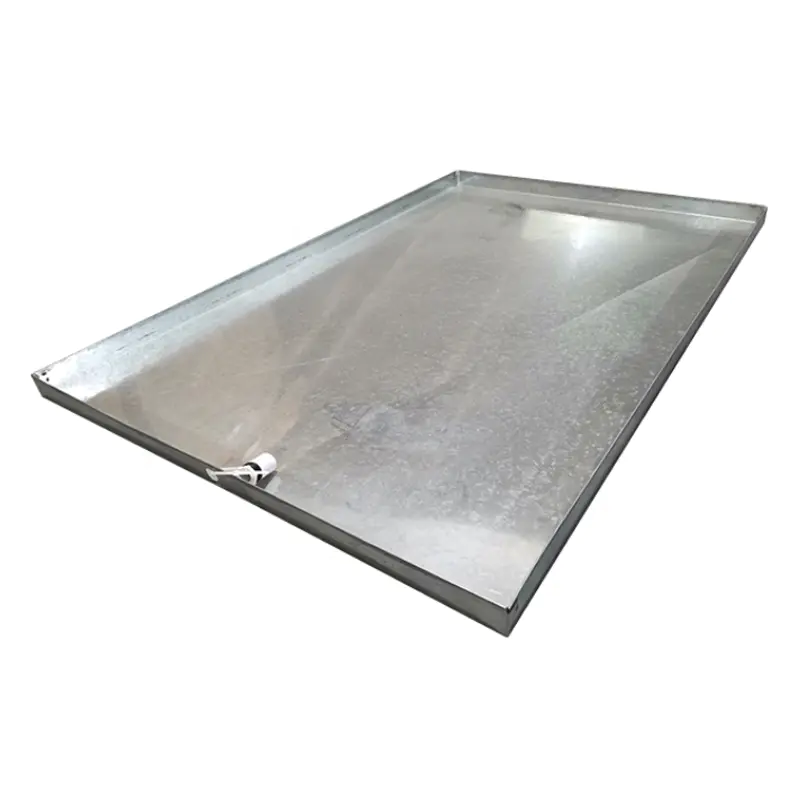
Galvanized Steel Moderate 6 to 10 years Residential and light commercial units
Stainless Steel High 12 to 20 years Commercial rooftop units and coastal climates
Aluminum Good 8 to 12 years Package units and lightweight retrofits
Molded Composite Fair 4 to 7 years Small residential air handlers
Galvanized 8 yrs Stainless 15 yrs Aluminum 10 yrs Composite 6 yrs

Typical service life in years by drain pan material before rust through or structural cracking becomes likely

Stainless Steel Condensate Pans for Demanding Environments

Stainless steel resists rust in humid, coastal, and high moisture mechanical rooms better than most other metal options, which is why many facility managers reach out to a stainless steel condensate pan supplier for a direct upgrade when a galvanized pan fails ahead of expectations. The tradeoff is that stainless components typically call for more careful fabrication to reach the same custom dimensions as lighter gauge metals.

Galvanized Steel and Aluminum for Standard Installations

A galvanized HVAC drain pan remains a common choice for standard residential and light commercial coils, offering a protective zinc layer that holds up well under normal indoor conditions. Aluminum pans trade some rigidity for reduced weight, which can simplify installation on tight coil assemblies or rooftop package units where every pound matters during a lift.

Corrosion Resistance Rigidity Lightweight Fabrication Flexibility

Darker outline represents stainless steel and lighter outline represents galvanized steel across four performance dimensions

Facility teams sourcing pans for custom coil dimensions frequently work directly with a metal AC drain pan manufacturer capable of producing exact depths, drain fitting placements, and mounting flange positions rather than adapting a universal stock pan that was never designed for the specific unit footprint.

A Practical Prevention Checklist for Homeowners and Facility Teams

Most HVAC drain pan overflow incidents are preventable with a short list of recurring habits rather than a single major repair. The checklist below reflects the maintenance steps that HVAC technicians most often recommend after an overflow service call.

  1. Flush the condensate drain line with a mild vinegar solution at the start of each cooling season
  2. Confirm the float switch trips correctly by lifting it manually and listening for the system to shut off
  3. Check the drain pan slope with a small level rather than assuming the unit itself is level
  4. Replace air filters on a consistent schedule to keep airflow across the coil from dropping too low
  5. Inspect the pan surface for rust spots, hairline cracks, or soft flexing under light pressure
  6. Keep a condensate pump, where one is installed, free of debris and test its float separately
  7. Clear vegetation and debris away from the outdoor drain line termination point
  8. Schedule a seasonal inspection before the humid months when condensate volume rises fastest

Recognizing When Repair Is Not Enough and Replacement Is Required

Some drain pan issues respond well to cleaning or a minor patch, while others signal that the pan itself has reached the end of its useful service life. Rust that has worked through the metal to create a visible pinhole, a pan that flexes noticeably under hand pressure, or a pattern of repeat overflow even after the drain line has been cleared are all signs that a patch will likely only delay the next call rather than resolve it.

Commercial HVAC drain pan replacement projects often involve coil assemblies that were installed years earlier using dimensions that are no longer produced as a common stock size, which means the replacement pan typically needs to be measured and fabricated to match the existing coil footprint rather than adapted from an off the shelf template. Facility teams planning this kind of replacement generally benefit most from confirming exact depth, width, and drain fitting placement before fabrication begins, since a pan that sits even slightly off center at the drain fitting can reintroduce the same overflow problem soon after installation.

Partnering With a Trusted HVAC Drain Pan Manufacturer

The condenser and the drain pan work together as core components inside a cooling system, with the condenser managing the heat exchange side of the refrigeration cycle while the drain pan collects and directs the condensate the system produces, keeping moisture away from surrounding structures and wiring.

Cixi Chenfeng Electric Co., Ltd is a manufacturer focused on central air conditioning accessories, working as a custom HVAC drain pan manufacturer and air conditioner drain pan production facility based in China. The company supports wholesale ODM and OEM customization requests, which allows buyers to specify pan dimensions, drain fitting placement, and material type rather than adapting a generic stock pan to a coil it was never designed for.

Working as a custom condensate drain pan supplier, the team draws on established technical experience across the central air conditioning accessories field to support both small production runs and larger ongoing supply arrangements for OEM partners who need consistent dimensional accuracy across every batch.

Frequently Asked Questions About HVAC Drain Pan Overflow

Q1: What is an air conditioner drain pan
It is the shallow tray positioned beneath the indoor evaporator coil that catches the water condensation produced as warm air passes over the cold coil surface, then channels that water toward the drain line.

Q2: What does a condensate drain pan do in HVAC
A condensate drain pan collects moisture pulled from indoor air during cooling and directs it safely out of the system, keeping water from dripping onto ceilings, floors, or nearby electrical components.

Q3: Do all air conditioners have drain pans
Nearly every split system, packaged unit, and ducted air handler includes a primary drain pan, and many indoor installations also include a secondary condensate overflow pan as a backup safeguard.

Q4: Why is my AC drain pan full of water
A full pan usually points to a blocked drain line, a drain trap that has lost its water seal, or a condensate pump that has stopped lifting water out of the pan.

Q5: Why is my HVAC drain pan overflowing
Overflow happens once incoming condensate exceeds what the drain line can carry away, commonly because of buildup inside the tubing, a pan installed without proper slope, or a float switch that should have shut the system down first.

Q6: How do I fix a cracked AC drain pan
Small hairline cracks can sometimes be sealed temporarily with a rated waterproof sealant, while a pan that is visibly rusted through or repeatedly leaking should be measured and replaced with a properly fitted pan rather than patched again.

Q7: How often should a condensate drain line be cleaned
Most technicians recommend flushing the drain line at the start of each cooling season and checking it again mid season in humid climates where buildup forms faster.

Q8: Can a dirty air filter cause drain pan overflow
Yes, a clogged filter restricts airflow across the coil, which can cause the coil to freeze, and when that ice later melts all at once it can produce more condensate than the pan and drain line handle at a normal pace.

Share:
Contact Us Now
Product
Related Product